
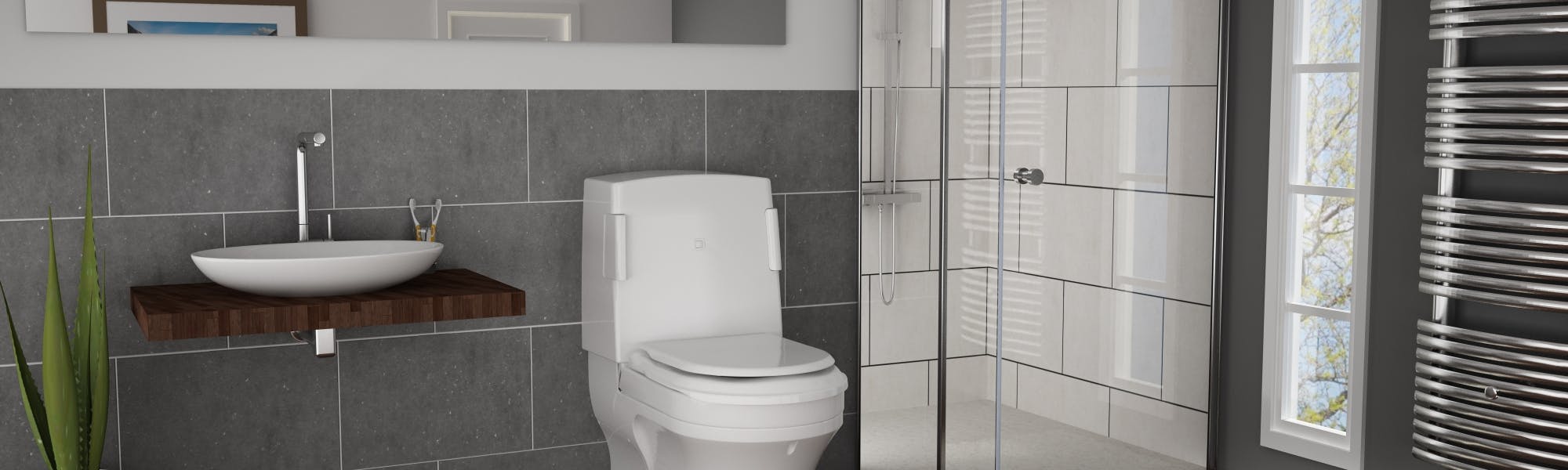

Types of Toilets for Disabled Users
Different mobility challenges require different solutions. Our specialists will help identify the most suitable toilet system based on your needs, bathroom layout and level of support required.
Different mobility challenges require different solutions. Our specialists will help identify the most suitable toilet system based on your needs, bathroom layout and level of support required.


Raised height toilets, often referred to as comfort height toilets, make it easier to sit down and stand up by slightly increasing the seat height. This reduces strain on the knees and joints and is particularly helpful for people with arthritis or limited mobility.
These toilets look similar to standard bathroom suites and can often be incorporated seamlessly into a modern accessible bathroom design.
Wash and dry toilets offer an advanced solution for maintaining hygiene and independence. With integrated washing and drying functions operated by a remote control or side panel, they allow users to manage personal hygiene comfortably without assistance.
These systems are especially beneficial for individuals with reduced dexterity or limited mobility, helping maintain dignity and independence at home. Watch the short video below to see how wash and dry toilet technology works in practice and learn more about our auto wash and dry toilet solutions.
Powered toilets are designed for users with significantly reduced lower-body strength. These specialist systems gently lift or tilt the user into a standing position, helping make transfers safer and easier.
They are often recommended for individuals with severe mobility limitations or progressive conditions.

Toilet lifters can be installed over an existing toilet and provide a lifting mechanism that assists users when standing up. They are often used as an intermediate solution for those who need additional support but may not yet require a full bathroom adaptation.

Creating a safe and accessible toilet space often involves more than simply replacing the toilet itself. Our specialists consider the entire layout to ensure comfort, safety and ease of use.
Grab Rails and Drop-Down Arms
Provide additional support and stability when transferring on and off the toilet.
Accessible Layouts
Sufficient space is essential, particularly for wheelchair users or those using mobility aids. Our team can advise on appropriate disabled toilet dimensions to ensure safe and comfortable movement.
Emergency Pull Cords
Offer reassurance by allowing help to be quickly summoned if needed.
Slip-Resistant Flooring
Often recommended alongside accessible bathroom adaptations to help reduce the risk of slips and falls.

Choosing the right disabled toilet or accessible bathroom solution is about far more than selecting equipment. Every person’s mobility needs, home layout and level of support are different, which is why expert guidance is so important.
At More Ability, our experienced specialists take the time to understand your individual needs and design solutions that prioritise safety, comfort and independence. All of our disabled bathrooms and disabled toilets are designed and installed by teams who specialise in inclusive bathroom design and understand the practical challenges many people face at home.
We provide a complete end-to-end service, managing everything from your initial consultation and home survey through to bespoke layout design, product specification and professional installation. Throughout the process you’ll work with the same dedicated team, giving you reassurance and continuity from start to finish.
Customers often choose More Ability for our experience, attention to detail and personal approach. This is reflected in our 5-star Trustpilot reviews, and you can also explore real customer case studies to see how we’ve helped homeowners across Yorkshire create safer and more accessible bathrooms.
If you're researching disabled toilet solutions for your home, these guides may also be useful:
> Disabled Toilet Dimensions – Understanding layout requirements and how accessible toilets can work in domestic bathrooms.
> Disabled Toilet Accessories – A guide to grab rails, raised seats and other features that can improve safety and independence.
The most suitable toilet depends on the user’s mobility and level of support required. Comfort height toilets may suit those with mild joint pain, while powered tilt systems or wash-dry toilets are often recommended for people with more significant mobility or dexterity challenges. Our specialists help determine the most appropriate solution.
Yes. Many disabled toilets include integrated washing and drying functions, helping users maintain hygiene independently without needing assistance.
Yes. Grab rails and drop-down support arms are often installed alongside disabled toilets to provide stability and support when transferring safely.
Yes. Accessible toilet solutions can often be designed to work within compact spaces. During a home assessment we evaluate the room layout and recommend the most suitable configuration.
Yes. If you have a chronic illness or disability, you may qualify for VAT exemption on certain bathroom adaptations and equipment, including disabled toilets and installation.

what our customers say
Richard was exceptional in his approach to his work, was organised, professional, informative, communicating each stage, worked continuously and outstanding skill in his finished work - a credit to your company.
Sue was very helpful and also a credit. Joe fixed the issues we encountered with great efficiency and professionalism.
Mr & Mrs Hirst, Knaresborough, Harrogate, North Yorkshire
Very professional from start to finish. A pleasure to have you in our home.
Mr Ainley, Pudsey, West Yorkshire
RE: Mr Clayton Morris, Electrician.
I would like to provide feedback about the above electrician who has just completed work on my new bathroom.
I found this gentleman very polite helpful & dependable. His work ethics are very commendable and i would appreciate him getting recognition for all he has done and his customer service skills.
(July 2017)
Mr Healey, Shipley, Bradford, West Yorkshire
Thank you for sending such an excellent team to do the work required in my bathroom.
I was very impressed by all of them and their very high standards.
My thanks to Dave who did the initial survey to the vinyl layers, plasterer and especially Jim.
Jim worked so hard. He kept me informed at every stage, making certain that everything he did was suitable and met my needs.
I am more than satisfied and delighted with the finished result.
Mrs Andrews, Holgate, York, North Yorkshire
I would like to thank everyone at more ability and your fitters - they were great and very clean.
(August 2015)
Mrs Cooper, Lundwood, Barnsley, South Yorkshire


More Ability is a trading name of B&K Passmore Limited. VAT Number: 168830436
Company Number: 4164081. Registered in England & Wales. Private Limited Company.
Head Office & Leeds Showroom: Partnership House, 6 Hales Road, Wortley, Leeds, West Yorkshire, LS12 4PL
Harrogate Showroom: Unit 1 & 2 Beech Avenue Business Park, Beech Avenue, Harrogate, North Yorkshire, HG2 8DS
Otley Showroom: 1A Walkergate, Otley, North Yorkshire, LS21 1HB
Mirfield Concession Showroom: Whiteleys Garden Centre, Far Common Road, Mirfield, West Yorkshire, WF14 0DQ
managed by oa.
.jpg?auto=compress%2Cformat&cs=strip&fit=clip&h=400&ixlib=php-1.1.0&w=400&s=0d082fb2ac66bad4036d0e4bf509ff36)


